
19 May 2026
National Highways bin and got a new talking device to tackle A303 litter
A new talking bin has been unveiled alongside the A303 in a joint National Highways and East Devon District Council initiative aimed at tackling roadside litter.
The new talking compacting bin has been installed in a layby near Upottery, and will be monitored as a trial, with the aim of rolling out further bins in the future.
The new bin – the first installed by National Highways on a South West roadside – has a larger, 570-litre capacity than standard bins and operates by compacting the waste people drop into the machine.
Working on sensors, the bin will indicate when it’s reaching capacity and message East Devon’s Streetscene teams when full, saving operatives time on their collection routes – and it will even offer up a courtesy ‘thank you’ message to any responsible drivers using the bin during their travel breaks!

Caption: National Highways Inspections Manager Mark Bird and Barry Mason, East Devon District Council’s Streetscene Area Officer, at the A303 layby near Upottery
Litter collection along the A303 and other major A roads costs local councils millions of pounds each year and by compacting waste, the new bin will save costs by reducing the number of collection visits.
Elsewhere, two compacting bins are also being installed along the A2 in Kent, in partnership with Dover District Council.
Andrew Gale, South West Service Manager for National Highways, said: “We work closely with our local authority partners and we’re hoping that we’ll see a further roll-out of these bins across our laybys in the coming years, and a significant reduction in the amount of litter on our roadsides.
“Clearing litter from our roads costs the taxpayer millions of pounds a year, and the aim here is to reduce the number of collections and ultimately costs, which councils can ill afford – and if the bins are treated correctly they’ll even speak nicely to you!”
The compacting bin initiative has been funded through National Highways Designated Funding, which is set aside to deliver benefits beyond its core road investment programme, and the trial is forecast to see:
- an 80% reduction in maintenance hours;
- 66% fewer emptying trips;
- lower carbon emissions;
- a £30,000 cost benefit over five years.
Barry Mason, Streetscene Area Officer for East Devon District Council, said: “We are delighted to be working together with National Highways. This new bin has the capability to text our operatives when full and this technology will allow us to optimise our collections and volumes collected while helping to keep our roads clean.”
As part of the Great British Spring Clean effort earlier in the spring, National Highways’ teams have just collected close to three tonnes of litter from roads in the South West.
During the spring clean effort in the region, National Highways’ contractors collected 428 bags of litter from its motorways, the A417/A419 routes in Gloucestershire and Wiltshire and the A35 in Dorset – at 7kg a bag, equivalent to 2,814kg or 2.8 tonnes.
Since last April to the end of March this year, in the South West alone, National Highways has seen 3,952 bags collected, equating to a staggering 27,664 kilos – or 28 tonnes of litter.
Having supported Keep Britain Tidy’s campaign for 11 years, the company, responsible for England’s motorways and major A roads, has organised community events, nighttime sweeps and staff volunteer events during this year’s big spring clean in a bid to tackle roadside rubbish across the country.

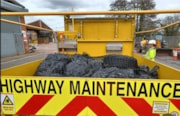
Caption: Above and below, some of the litter collected by National Highways contractors at the Chelston depot during the Great British Spring Clean

Mr Gale added: “Litter is a huge issue and while it was good to be involved in the Great British Spring Clean, it’s an everyday activity for our contractors, keeping on top of the litter blight.
“Roadside litter is not just unsightly but it’s a threat to wildlife and the environment and it can also be a safety hazard for drivers, can block drains and picking it up puts roadworkers at risk.
“Our advice to drivers is clear: don’t drop litter. Please use any bins provided in laybys, heed the signage, and keep a bag in your car to store litter until you can dispose of it responsibly.”
The Great British Spring Clean campaign took place from 13 to 29 March, and while National Highways’ contractors clear litter on motorways and a small number of A roads, litter on the majority of A roads falls on local authorities to clear, and in order that it can be collected safely National Highways also teams up with councils to co-ordinate any necessary closures.
People can find out for more information about the company’s litter strategy here, while maintenance issues can be reported to National Highways online or by calling 0300 123 5000.
About National Highways
National Highways is the wholly government-owned company responsible for modernising, maintaining and operating England’s motorways and major A roads.
View our press releases online at https://nationalhighways.co.uk/press/
Traffic information for England’s motorways and major A roads is available via the website https://nationalhighways.co.uk/, local and national radio travel bulletins, electronic road signs and mobile apps. Local X services are also available at http://nationalhighways.co.uk/about-us/social-media-use/.
For further information please contact National Highways' press office (24hrs) on 0844 693 1448 and select the most appropriate option below:
Option 1: National enquiries (9am to 5.30pm) & out of hours for urgent enquiries
Option 2: North West (between 9am & 5.30pm)
Option 3: Yorkshire, Humber and North East (between 9am & 5.30pm)
Option 4: West Midlands (between 9am & 5.30pm)
Option 5: East Midlands (between 9am & 5.30pm)
Option 6: East (between 9am & 5.30pm)
Option 7: South East (between 9am & 5.30pm)
Option 8: South West (between 9am & 5.30pm)



Powered by Onclusive PR Manager © 2026